STEP ONE
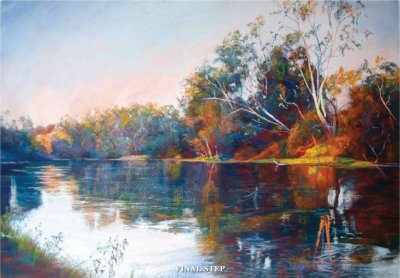
I did a minimal drawing with a light blue pastel pencil to establish the overall composition; and the line of the river bank and placement of trees.

STEP ONE
I did a minimal drawing with a light blue pastel pencil to establish the overall composition; and the line of the river bank and placement of trees.
STEP ONE
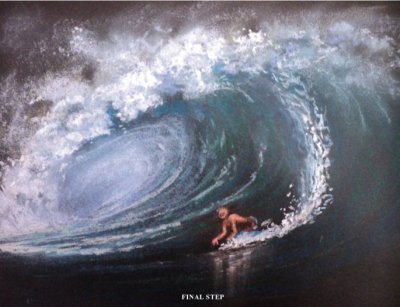
Very basic application here of a squiggly line to represent the top of the wave, running left to right and down the right hand slope of the gathering section of the wave…

STEP ONE
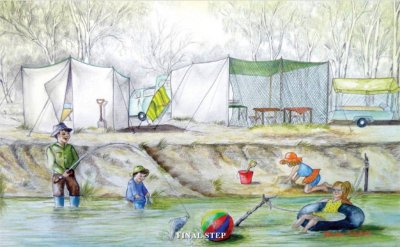
Pencil sketch for composition While the initial rough sketch usually takes the least physical time of the whole painting process, it can take a considerable period to settle on the right composition before putting pencil to watercolour paper.
STEP ONE
I’ve chosen to paint a sunny fun day in the water! On a quarter sheet of 640g H/P watercolour paper I have airbrushed a background using Cadmium yellow and Cobalt in separate washes.
STEP ONE
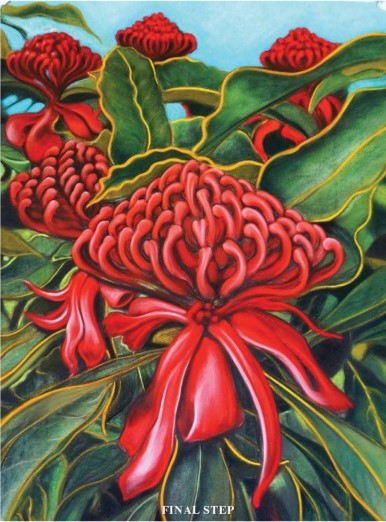
To begin a work, I always use a soft thin charcoal stick. Quite a few. This is good for shading and structuring the composition. I also use my hands and fingers to help shape the forms of the work.
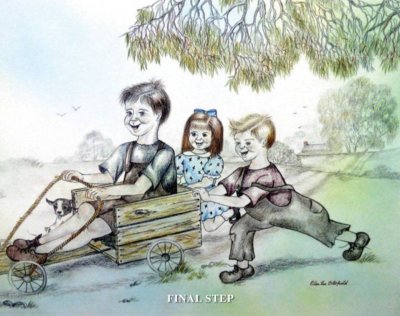
STEP ONE
On my 640g HP watercolour paper I have lightly airbrushed some Yellow light, Cobalt blue and Viridian. Once this had dried completely I sketched up my design.
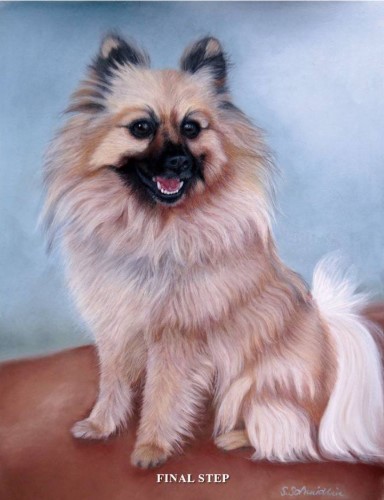
STEP ONE
Once I have an animal in mind which I am interested in painting, I ask the owners if I can take some photos. In this case it is a neighbour’s dog, a Pomeranian called Max.
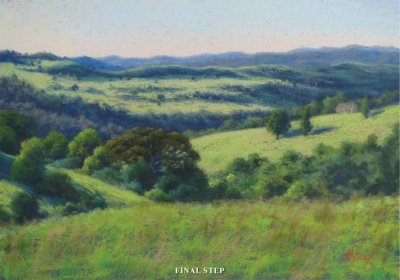
STEP ONE
Using the recent plein air pastel painting as my reference and with a stick of Vine Charcoal, I drew in the major shapes of my landscape composition on to a half sheet of Art Spectrum Storm Blue Colourfix sanded paper.

STEP ONE
After tracing the drawing onto the scratchboard using Loew Cornell transfer paper, I have scratched the major lines and area around the eyes and ears using a scalpel

STEP ONE
Using the photo as reference material, I crop it to what I regard as an interesting part, then alter the line of the wave to help create distance and lead the eye further into the composition.