
MATERIALS
• Colourfix Paper, Aubergine.
• Art Spectrum and Holbein Pastels.
• Charcoal Pencils – Pastel Pencils (Conte and Derwent).
• Colour Shapers and Paper Stump.
• Hog Hair Brush.
• Plastic Eraser.
• Mahl Stick to keep my hands off parts I don’t wish to smudge.
• Measuring Apparatus (use what you like, but be consistent).
STEP ONE
I define a clear border to contain the end result and leave reasonable space all around to facilitate handling. This space includes an area to “test blend’ colours. I use charcoal pencils and a brown pastel pencil to formulate the major shapes, before adding a light pink around the ears.

STEP TWO
The emphasis is now on the ears and eyes. I use a light pinkish colour for the ears and blend gently with my fingers, adding a little grey violet for the shadows. The eyes begin with a basic colour (in this instance a pale yellow) which is blended with a paper stump. Other colours, shadows and lights are added, followed by the pupil. Black pastel pencil is useful for this task. A basic colour is then applied to the nose, adding darks and highlights plus the black area around the nose.

STEP THREE
The whole body receives a thin layer of basic colour dragged lightly over the paper and gently blended. The ‘white’ sections of fur are done in pale warm grey, blended with my fingers before adding grey violet in the shadow areas.

STEP FOUR
My attention now turns to the background, and I work outwards from the animal – trying to keep the pastel at an uneven width, avoiding a ‘halo’ effect around the subject. I then add more grey violet to the ‘white fur’ shadows.

STEP FIVE
The background is now blended in with the fingers, whilst adding lights and darks as necessary. I touch up the ears to eliminate smudges from the background work.

STEP SIX
This is a critical stage of the painting’s progress, where attention turns to the fur. The fur has many colours (nobody makes ‘tabby cat’ pastels), which include black, browns, gingers, plus pale and dark yellows. The key for me is to utilise tiny strokes and display a great deal of patience.

STEP SEVEN
It’s time to get up close and personal. This cat (whose name is T.C.) is now ten years old and I’ve just discovered that all the hairs in his ears are not white. Adjustments are required. I now tackle the fluffy white stuff on his chin, chest and tummy area using grey violet where necessary to make the true white areas stand out. White pastels are used on the top layer. I then add the whiskers with the edge of a white pastel (a pencil will not do).

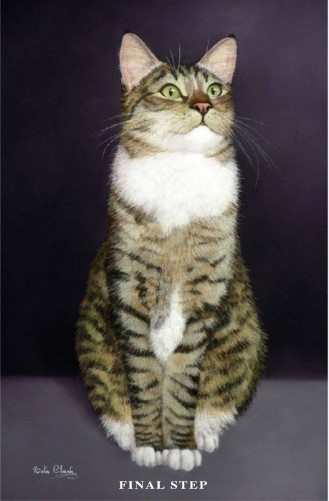
FINAL STEP
Resist the temptation to do more than necessary. This is the time to retreat and admire your work, stepping forward again only to add your signature.

MASTER HINTS AND TIPS
• Paper stumps are excellent to blend the first layer of pastel. They can be used to remove excess pastel, and are useful to stabilise a drawing so that it does not smudge.
• Colour shapers are very useful to blend heavier pastel if you require a smooth finish; also very good for applying highlights to eyes.
• Larger colour shapers can be used to blend and smooth other areas.
• To clean paper stumps, I use sandpaper (glued to a piece of craft board).
• To sharpen pastel pencils I use a good quality pencil sharpener.Alternatively, a craft knife (used carefully) will produce an excellent result.
• I use a plastic eraser on the pastel after first removing excess pastel with my finger or paper stump, or even a bristle brush. The remainder is easily removed with the eraser.
• A paper tray is handy to catch dust from your painting. Stiff paper folded in half lengthwise can be attached to the easel at the bottom of your work (7 or 8 cm wide is enough).
• Do not blow pastel when you have too much on the paper. You (or someone else) will breathe in whatever you blow into the air. Good quality pastels do not contain nasty chemicals, but a lung full of dust is something you can do without. Tap your paper, or flick it, and the pastel will fall into the desired receptacle.
DOGS’ AND CATS’ EYES
The basic difference when illustrating the eyes of dogs and cats relates to the difference in pupil structure. The pupils of cats’ eyes vary (according to light) from a slit to a large black ball. The pupils of dogs’ eyes are round, and soften gradually into their basic colour. Cats’ eyes are relative (proportionwise) to their size, whilst dogs’ eye sizes vary enormously.