MATERIALS
• Canson mi tientes paper
• Charcoal white
• Black biro
• Black Chinagraph
• White oil pastel (brand Van Gogh)
STEP ONE
I saw all these amazing coloured pastel papers in one of the art shops I frequent, and the blue colours really caught my eye. I bought a bunch of different hues of blue and couldn’t wait to get started. For this piece I chose one of the darker colours, something a bit out of my comfort zone.
I use several images as reference, usually from my own photographs and the “punter section in the newspapers is also a great resource for me. I begin the drawing by mapping out the proportions. I keep it very light and loose, and work fairly quickly, as I’m looking at the big picture, not even thinking about details at this stage. I don’t use an eraser so it can get quite messy, however keeping it light means it all gets coloured over eventually.

STEP TWO
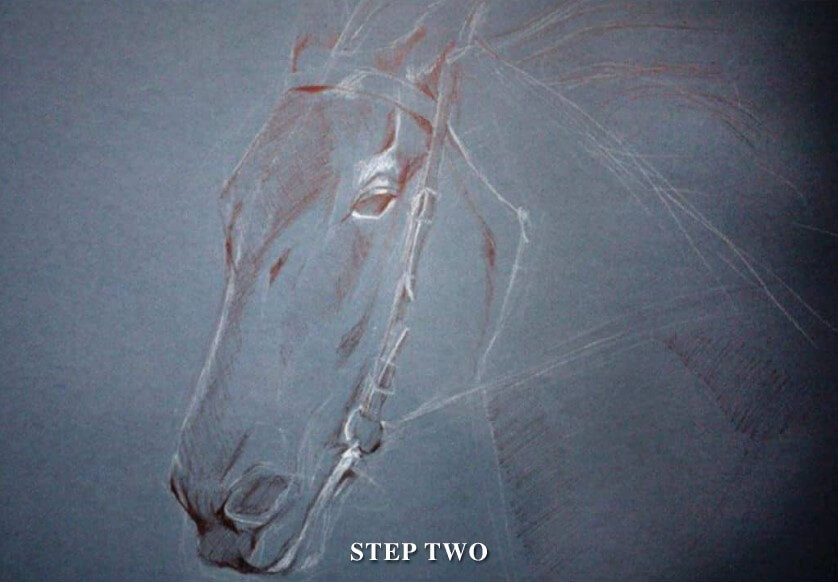
This stage is used to define exactly how I want the shape of the horse to look like; I’m `setting things in stone so to speak. I have a definite outline and begin tightening the drawing by colouring the darkest areas and start introducing some highlights. I use biro at this stage as it’s not overbearing, and really adds discipline to the details I know I’m going to need.
STEP THREE
I don’t have a definite plan of how I want the drawing to finish up looking like, but I know I really like the way my white oil pastel is looking on this paper. Many of my drawings are a means of discovery and a process of learning when using new materials. A lot of time I just go with where the drawing takes me. Because I like the white, I decide I’m going to complete the bulk of the drawing in this colour, so large plains of white are shaded in with darker details etched into the piece. I’m using oil pastel (Van Gogh brand) for the white and Chinagraph for the black. Chinagraph is commonly used amongst construction workers because it can work on many surfaces. I find it gives my drawings a nice glossy finish.

STEP FOUR
The bulk of the drawing is completed at this stage. The entire horse is now shaded in, the lights and darks, the shadows, and the very finest details are all worked on. I get fairly ‘forensic’ at this step – making sure I really get the details right. I also get heavy handed with the highlights – I’ve been known to break many a pastel and pencil when using white. I also walk away from the drawing, take a break from it. It tends to get stale’ when sweating over details for hours.

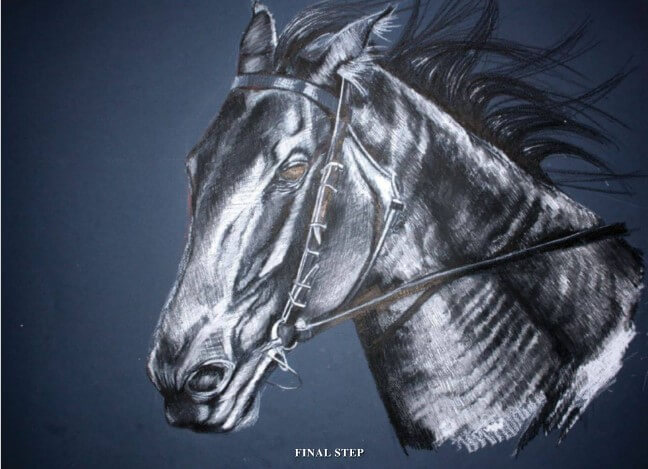
FINAL STEP
After a night, I look at the drawing with ‘fresh eyes’. It’s pretty much finished, but I fine tune it, adding more detail, lightening a highlight, touching up an edge, blending another area. This could continue forever. I regard it as complete when I’m satisfied there’s enough detail. More than enough is never enough!
ARTIST’S HINTS AND TIPS
• Take time to get the proportions of your drawing right, this is the most important step. Look at it in reverse by facing a mirror, as sometimes you need to look at it from a different view.
• In the beginning, keep it loose and work with some speed, don’t get caught up with details; that comes later.
• Don’t get too overwhelmed by details, it may help by focusing on one part at a time i.e. the ear section, the eye and work around and up from there.
• If you get stuck, don’t give up, take time away from the piece and come back with a fresh perspective or renewed energy.
• Try to understand your subject as much as you can.
• Have fun with it! Turn up the music – and if you make mistakes – who cares? It’s not a life and death situation. It’s an adventure!