MATERIALS
PAINTS
• More often than not I start my watercolours with ‘Maimeri Blu’ Stain de Gran Bruin. I like this reddish brown because it’s transparent, and almost nonstaining. It melts into my next washes, and always creates a warm undertone for flesh colours. Being transparent it doesn’t muddy up the top layers as would Yellow Ochre or Sienna. It works well for monochromatic studies too. Other colours I use frequently are: Ultramarine, Cobalt Blue, Alizarin, Cadmium Red, Cadmium Yellow, Yellow Ochre, Australian Red Gold, Burnt Sienna, Chinese White.
• Arches 300gsm rough paper
• Robert Wade Neef Taklon brushes:
• Round size 2 (970 series)
• Round size 5 (970)
• Flat size 5/8 (980)
• Filbert size 14 (988)
• These are relatively inexpensive brushes, but they last for ages, and I’d rather spend extra on quality paints.I buy the best I can afford.
• HB pencil
• Kneadable eraser
I’ve developed my own drawing techniques and my own approach to watercolour painting, and I love to share the ‘what ifs’ I’ve learned over the years to make watercolour painting less daunting for beginners (and for myself). Whenever I demonstrate my technique now, it’s amazing how many students immediately want to commence painting with watercolours. The fear vanishes.
STEP ONE
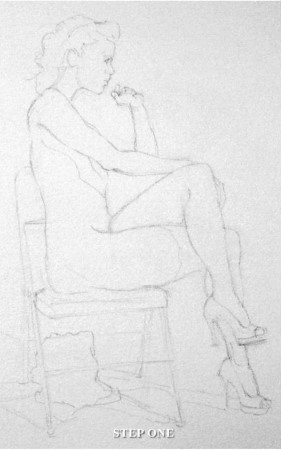
I start with a pencil drawing directly onto the Arches paper, pressing lightly with the HB pencil. Were I to use a soft pencil, like 6B, it would smear on my white paper and would tend to muddy up my subsequent paints. Don’t be afraid to use the kneaded eraser to adjust your drawing. It doesn’t mean you’ve made a mistake, it just means you’re making an improvement, It’s really worthwhile to take plenty of time with the initial drawing.
At this stage I decide which lines I can leave out. I don’t want to have to tell the viewer everything. I want to leave out some of the detail for the viewer’s imagination to become involved. When I’m happy with my drawing and proportions, my plan of lost and found lines, soft and hard edges, I’m ready to begin the painting process. But first I take my kneaded rubber and very lightly roll it over.
STEP TWO
I squeeze a dab of the reddish brown onto my palette, and I begin with no water. I drag it onto the paper using a dry brush drawing technique because I want the paint to stay on the surface, not to seep down into the grain of the paper. It dries quickly, and then I go over it all again with my kneaded eraser, this time removing the remaining pencil marks.

STEP THREE
The underpainting is dry, but when I add water, it becomes soluble again and I can push pull it wherever edits are needed. Everything is easily adjustable at this stage. I can even take off most of the underpainting if I need to. Because it is watercolour, I add plenty of water. I want to keep the underlayer transparent, even in the shadows, because my objective is to put several more colours there.
I have my board angled at about 45 degrees.
STEP FOUR
I’ve created some passages where the shadows bleed together, and in the final painting, this is where I am going to lose a lot of the detail. This will help to ground the figure and ‘sit’ her in the chair, rather than looking as if she’s stuck on it afterwards. The only real straight lines should be kept to the furniture, not on the figure. I also want to create breaks where I can let the light in. These will only be on the light-struck side of the subject. It’s like opening a little gate in the edge line and letting a pattern of light flood in, and I do think of it as a pattern. It has to have a natural ‘flow’, so it’s important to be always conscious of the light direction. Sometimes I alter part of the light pattern or even ignore a patch altogether if I envisage an improvement of the design or the aesthetics of the end result.

STEP FIVE
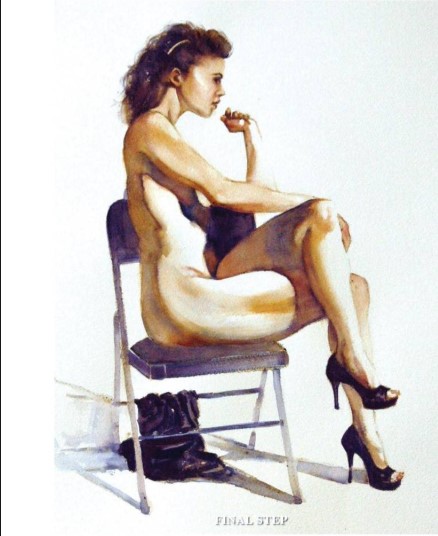
Now is where the interesting bit begins, and the watercolour takes over! I start to flood in some other colours. In this example, I’ve used Alizarin and Ultramarine in varying strengths. You can see how the warm under painting mixes with this next wash. Some of the little blobs still show through, but mostly I like the way that looks. I can still wet them and blend them in if I need to. Then I’ve added Cadmium Red to the Ultramarine for the darkest representation of her shoes and discarded sarong.

FINAL STEP
Next I’ve warmed up the skin with washes of Australian Red Gold and Cadmium Red, adding a touch of the previously mixed purple to my wash, toning it down a fraction. Then lastly, I’ve washed in a smidgeon of Magenta to make the red shadows glow a little more.
Because I use 300gsm strong paper I can adjust small areas of the painting by scrubbing out gently with a small stiff bristle brush if needed. Sometimes I might use Chinese white on a tiny brush to add a highlight to hair or lips, or to reclaim a small light on the point of a shoulder.
Then put the painting away and look at it with a fresh eye the next day.