
MATERIALS
• Fabriano paper 250gsm.
• Derwent graphite pencils in soft and hard ranges (4B, 2B, HB, H, 2H).
• Staedtler mechanical pencils 0.3, 0.5 and 0.9 width; with HB and 2B leads.
• Tortillon stumps.
• Colour blender.
• Blu Tack.
• Masonite board.
• Bulldog clips.
• Blank A4 paper.
• Tracing paper.
STEP ONE
I chose several different reference photographs of elephants from the Internet, books and newspapers, and practiced several small sketches of elephant compositions. When content, I graphed up a piece of tracing paper using lcm squares and placed this over the final draft composition. I enlarged the composition (three times larger than the draft) and graphed up the Fabriano paper using HB pencil, being sure to press lightly to ensure that lines could be easily erased when finished. I transferred the composition and decided the source of lighting was to come from behind and to the right.
I had not drawn on this type of paper before, so on a spare piece of Fabriano I practiced tonal variety using each grade of graphite. This was essential as different papers will provide different qualities. I also used a tonal scale I made myself to judge different greys on the reference photographs. I chose to only draw half of the left elephant, to really place him in the background and to add interest to the composition.

STEP TWO
I began the drawing from the left upper corner and worked diagonally towards the right lower corner to prevent smudging. I also used the spare A4 paper to rest my hand on, to guard against transferring oils from my hand to the paper. I never use a finger to blend or smudge; oil marks on the paper will never come off.
The sky was created using 2B, HB and H graphite – graduated and blended using the tortillon stump. I then used Blu Tack to remove and smooth the tone until I was happy. The first elephant on the left was drawn with 2B and HB, using little detail and tonal variety to force him into the background. The baby elephant was drawn using HB and H with lighter tones and greater detail … I really wanted the baby to be the focus.

STEP THREE
I was really unhappy with the texture I had created on the mum’s belly and, after working on it for hours, I erased the whole lot and started again. I discovered that Fabriano paper can take a battering without tearing. After redoing the belly twice, I was happy. I then proceeded to the eye. The mum’s eye has the darkest darks and the lightest light, to draw the viewer’s eye to it and to create visual interest between the eye and the baby elephant.

STEP FOUR
Tonal shading was worked on further – paying attention to the highlights, cast shadows and reflected lights.
I use my mechanical pencils when I need a really crisp sharp edge, and I aim for the widest possible range in the mid tones to create reality and interest.

STEP FIVE
Almost done. By this stage, I always become anxious about wrecking the drawing; and I become very protective. I use a large sheet of tracing paper to cover the work at all times when I’m having a break. I have lots of breaks!
It is really difficult for me to be objective about my own art. My partner and kids are my fiercest critics. After the initial ego blow, I always take on board their suggestions and generally find that they are right.
I continued to work on tonal variation – lightening mum’s ear and forehead to bring them forward.
I started the grass and decided that the drawing was so detailed that I would keep the grass simple and minimal, to allow the viewer’s brain to perceive rather than see it. I also didn’t want the grass to pull attention away from the main focus. I completed the tusks with HB, H and 2H in light strokes.

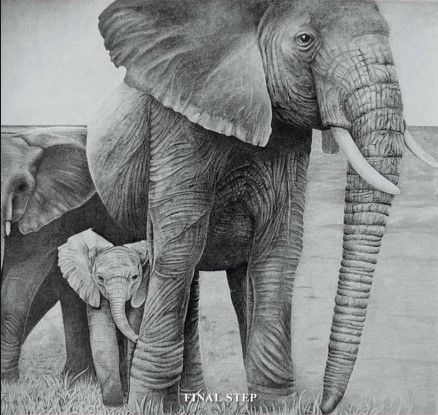
FINAL STEP
The picture was finished, ready for framing.

MASTER HINTS AND TIPS
• Stepping outside your studio and looking at the world around you is often where you will find the greatest source of artistic inspiration. Lots of quick little sketches – no matter how insignificant they may seem – are great building blocks for larger ideas and final compositions.
• Once I have a clear image in my mind and a tonal sketch on paper, the confidence to paint comes easily.
• Take the telephone off the hook when doing wet-on-wet areas such as large background washes.
•Having chosen and laid out the colours you wish to paint with, do a small rough painting of your idea. This, together with your tonal sketch, can help as a ‘memory bank’ for your final painting.
•Keep at least three jars of water beside you, and use one of these purely for rinsing out your brushes. Your other jars will be suitable for adding clean water to your paints. Regularly change the water and keep your palette clean.