Before I began the drawing, I washed the paper blue and let it dry completely.I accurately drew the swamp hen in first – from a series of photographs and some live sketches
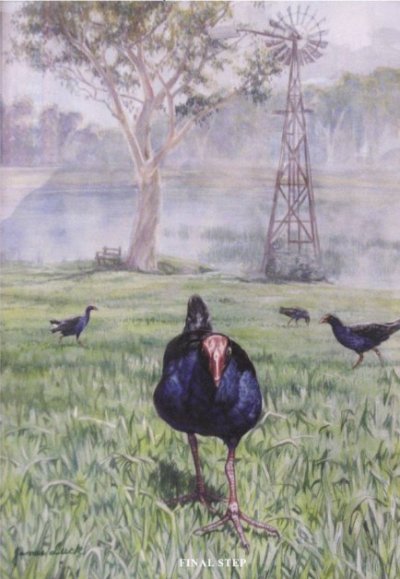

Before I began the drawing, I washed the paper blue and let it dry completely.I accurately drew the swamp hen in first – from a series of photographs and some live sketches

Once I have decided on the format of my painting, I mist a fine spray of water across the horizon line to dampen the canvas and diffuse the paint to give an initial sense of perspective.

I always start by painting the background, and when this is thoroughly dry I draw in my subject using a watercolour pencil. Any corrections that need to be made to the drawing can be easily wiped off with water.

This is the hardest step; finding a subject. Once that hurdle is overcome, I complete my drawing on tracing paper as it’s much easier to rub out mistakes or even turf out the drawing and start a new.

For this demonstration I will be painting a favourite bird of mine, a Red Capped Robin. Having selected a photograph, I draw the bird using grids to help me keep correct proportions.

Carefully draw outline shapes of each duck. Add in areas of reflection and water movements. The ducks were feeding at the time I saw them, so I added several lines in line with their bodies, but left area in front of the ducks.

For the base coat, I used an application of washes in complementary colours which would show through to the finished work; then I applied the shadowed areas in Violet.

Mix a thin wash of Raw Sienna, remembering that watercolour dries lighter. Wash in sky area. Mix mauve in a slightly stronger consistency than sky wash.
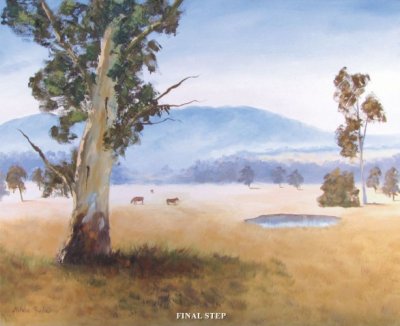
Lightly draw out with a HB pencil the outline of the gumtree, horizon line and the mountains. Mix Cobalt Blue and Titanium White and paint the top of the sky.
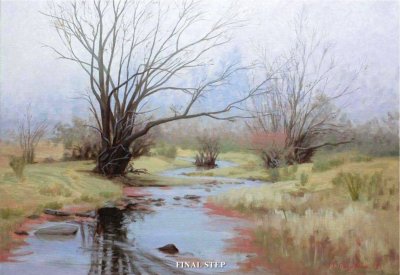
After a sketch, the painting started with a very thin wash of colours to cover the canvas, then I was wiping out some paint washes and correcting the painting to get the composition to sit.
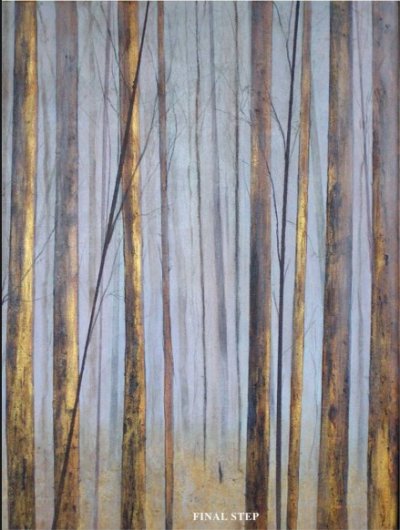
Working from several reference photographs I decide to paint a dry sclerophyll forest scene. I want to create a painting that captures the strength and beauty of tall gums and the atmosphere of a forest on a misty morning with the sunlight illuminating the trees.
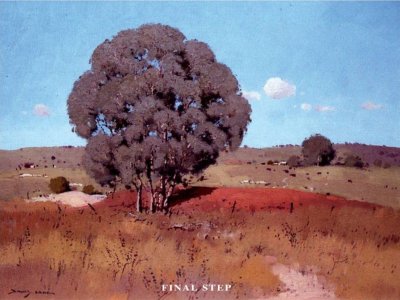
The tree in this painting is growing in the open, with a well-formed canopy. It is rather symmetrical (not unlike a light bulb). Being placed to the left of centre it is balanced by the much smaller and distant tree to the right and a shrub to the left.
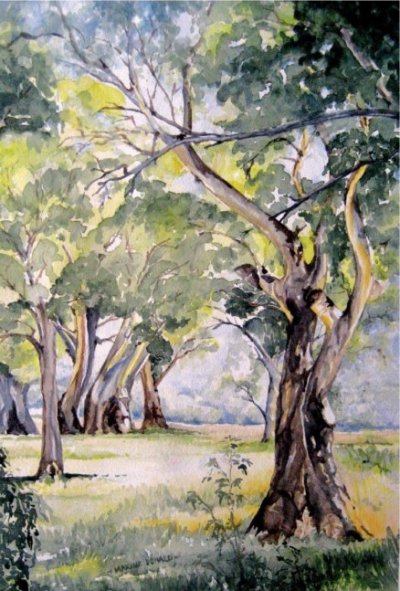
I trace the drawing lightly on to my watercolour paper. Tracing eliminates erasing any pencil lines on the watercolour paper, which can damage the paper’s surface.
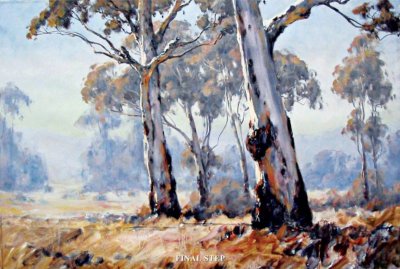
When I begin a painting, I seek to arrange the composition as best I can. Drawing and placement of the elements is important at this stage.

After reviewing the photographic reference, I choose the ones I feel best represent the model and the pose. I put all other reference material away and out of sight to concentrate only on the chosen photos.